
 By James William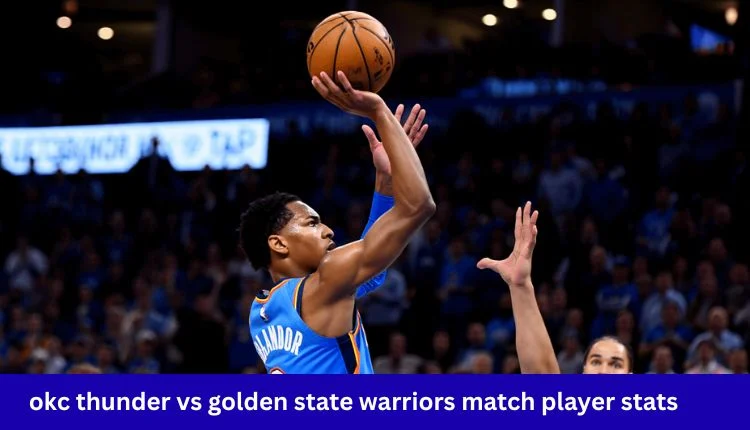
From the OKC Thunder vs Golden State Warriors match player stats, it was clear that both sides were ready to fight not only for points but also for momentum and self-confidence in the season. The fans witnessed a mixture of fast attack, disciplined defence, and individual brilliance that set the stage for an exciting game.
Known for their young, energetic roster, the Thunder showed their determination to prove themselves against one of the league’s most established teams. The Warriors, on the other hand, used their veteran leadership, sharpshooting ability, and championship experience to maintain control in critical stretches of the game.
Key artists from Oklahoma City
For the OKC Thunder vs Golden State Warriors match player stats, several players stood out with offensive contributions and defensive efforts. As expected, Shai Gilgeous-Alexander led the team in scoring and showed his trademark versatility. His ability to drive to the basket, pull up for mid-range jumpers and find teammates in transition presented constant challenges for the Warriors’ defence.
In addition to scoring, Gilgeous-Alexander contributed significantly in rebounds and assists, showcasing his all-around impact. He was complemented by Josh Giddey, whose court vision and passing ability kept Oklahoma City’s offense flowing. Giddey’s ability to find perimeter shooters and cutters in the lane added several layers to the Thunder’s offensive strategies.
Defensively, the Thunder relied heavily on their frontcourt players to contest shots and grab rebounds. Chet Holmgren, despite being a freshman, showed impressive block timing and the ability to change shots without fouling. His presence in the paint was critical in slowing down the Warriors’ interior scoring opportunities.
Golden State Warriors Offensive Brilliance
True to their reputation, the OKC Thunder vs Golden State Warriors match player stats relied on a combination of shooting accuracy and ball movement. Stephen Curry was unsurprisingly the highlight of the night, dazzling the crowd with deep threes and quick drives to the rim. Curry’s ability to score forced the Thunder to adjust their defensive schemes, often drawing multiple defenders to him and creating open looks for his teammates.
Klay Thompson complemented Curry well, spaced the floor and hit some perimeter shots that kept the Thunder defence on edge. Their duo’s synergy and ability to exploit defensive mismatches made them difficult to handle. In addition, Andrew Wiggins made significant contributions with a quick drive and defensive intensity, giving the Warriors a reliable secondary scoring option and an athletic presence on both ends of the court.
The Warriors also benefited from contributions from the bench. Players like Kevon Looney and Jordan Poole provided crucial minutes; Looney’s rebounding and interior defence stabilised the team, and Poole’s energy translated into scoring in crucial moments.
Statistical battle across the OKC Thunder vs Golden State Warriors match player stats
The match featured impressive individual performances that reflected the strengths and strategies of both teams. Shai Gilgeous-Alexander finished the night with a high score, combining efficient shooting with a high number of free throw attempts, indicating his ability to challenge the Warriors’ defence. Josh Giddey’s assist-to-turnover ratio was remarkable, showing careful ball handling while facilitating the Thunder’s offence.
For the OKC Thunder vs Golden State Warriors match player stats, Stephen Curry’s shooting percentage from three-point range remained consistent with his season average, underscoring his reputation as one of the most dangerous shooters in NBA history. Klay Thompson’s scoring efficiency further bolstered Golden State’s offensive firepower, while Wiggins’ contributions on both ends highlighted his versatility and importance to the team.
Rebounds played a key role in the outcome of the game. The OKC Thunder vs Golden State Warriors match player stats, led by Looney, was able to limit second-chance points, while the Thunder relied on Holmgren and other big men to create opportunities off missed shots. Turnovers were another critical factor, with each team capitalising on their opponent’s mistakes to score points for fast breaks and swing momentum.
The influence of OKC Thunder vs Golden State Warriors match player stats
Both teams entered the match with different approaches. Emphasising speed and a transition offence, the Thunder relied on the agility of their younger players to create open shots and scoring opportunities. Their defensive scheme focused on disrupting the Warriors’ perimeter shooting, with the goal of forcing turnovers and pushing the tempo.
The OKC Thunder vs Golden State Warriors match player stats, on the other hand, used structured ball movement and pick-and-roll action to generate a high percentage of scoring chances. The Warriors’ coaching staff rotated players effectively to maintain energy levels and counter the Thunder’s fast-paced offence. This strategic adaptability allowed Golden State to dominate key periods of the game, especially in the second half when execution became even more critical.
The use of the benchmark also played a large role in influencing the momentum. The Warriors’ rotation ensured their starters stayed fresh in key stretches, while the Thunder struggled to maintain intensity with a mix of starters and promising young talent. This tactical decision-making underscored the importance of NBA matchup depth and its impact on statistical output.
Defensive strengths and challenges
Defensively, both teams had great moments as well as weak spots. The Thunder’s young core showed energy and commitment, often rotating quickly to contest shots and block lanes. However, occasional turnovers allowed the Warriors to capitalise on open three-point opportunities and create high-percentage scoring chances.
The OKC Thunder vs Golden State Warriors match player stats defensive approach involved using their experience to anticipate offensive moves and disrupt passes. Players like Wiggins and Draymond Green (when active in the game) were instrumental in providing rim protection, competing for shots, and initiating fast breaks after defensive stops. Despite their defensive discipline, the Thunder’s aggressive drives and creative passing occasionally penetrated Golden State’s setup, leading to key plays.
Key takeaways
The reinforced several key aspects of modern NBA basketball. Quick transitions, three-point shooting and versatile scoring were essential to the flow of the game. Individual brilliance combined with cohesive team strategies creates a spectacle for fans and analysts alike.
Shai Gilgeous-Alexander and Stephen Curry have emerged as major influencers, dictating offensive rhythms and producing clutch plays. Young Thunder players like Holmgren and Giddey gained valuable experience against seasoned opponents and showed potential for future development.
The statistical breakdown highlighted the importance of shooting accuracy, assist-to-turnover ratio, rebounding, and defensive execution. These metrics not only reflected individual contributions but also provided insight into how both teams approached offensive and defensive challenges.
Conclusion
The OKC Thunder vs Golden State Warriors match player stats was a captivating contest that combined individual brilliance, tactical depth, and high-intensity action. While the Warriors leveraged experience and sharpshooting to maintain an edge, the Thunder’s youthful energy and emerging talent made it a highly competitive encounter.
The performance of key players like Shai Gilgeous-Alexander and Stephen Curry illustrated the impact of star power, while contributions from secondary players emphasised the importance of team dynamics. Ultimately, the game provided fans with an unforgettable night of basketball and valuable insights into the evolving strengths of both teams.
FAQs
Who were the top scorers in the game?
while Stephen Curry was the top scorer for the Warriors, both showcasing offensive versatility.
How did the bench players impact the game?
Bench contributions were crucial, with players providing scoring bursts, defensive support, and maintaining team energy during critical moments.
Which team dominated in rebounds?
The frontcourt controlled most rebounds, limiting second-chance opportunities, although the Thunder’s big men also made significant contributions.
Were there any standout defensive performances?
Chet Holmgren for the Thunder showed excellent shot-blocking ability, while the Warriors’ defensive veterans disrupted passing lanes and contested multiple shots.
Did turnovers affect the outcome?
Yes, both teams capitalised on turnovers to generate fast-break points, demonstrating the critical role of ball security in determining momentum.